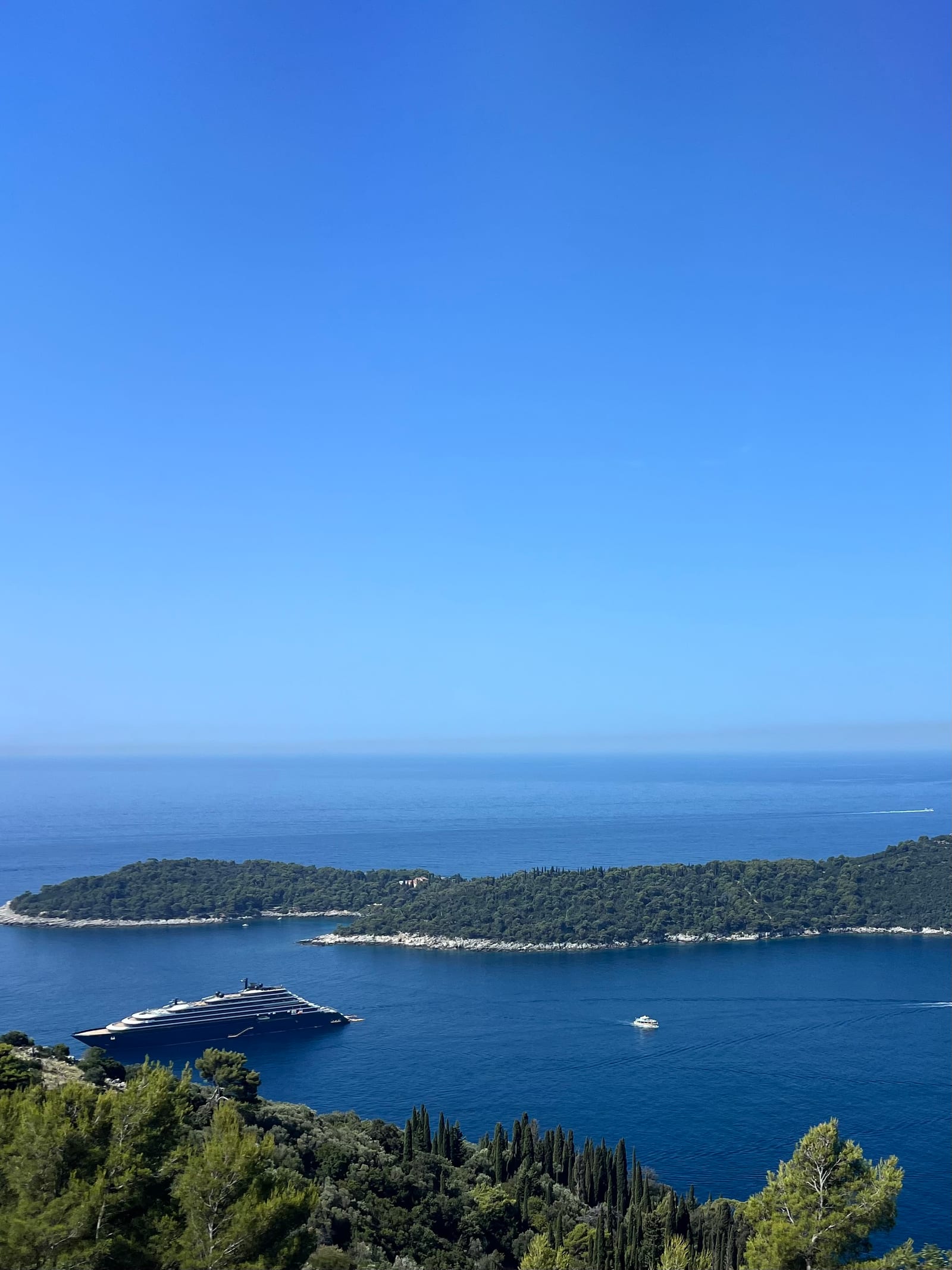
East Dubrovnik approaching the cable car area

Dubrovnik

Stradun to Mount Srđ — Dubrovnik Panorama Route

The route at a glance

  1. 1 Pile Gate — start of route start — western entrance to the old town
  2. 2 Stradun — crossing the old town 300m east down the main street from Pile Gate
  3. 3 Ploče Gate — exiting the old town east 5 min walk from Luža Square — follow signs east
  4. 4 Cable car lower station 15 min walk uphill from Ploče Gate — follow signs for Žičara / Cable Car
  5. 5 Cable car ascent — or Serpentine hike 4 minutes (cable car) or 1–1.5 hours (hike)
  6. 6 Mount Srđ summit — 412 metres 2 min walk from upper cable car station
  7. 7 Fort Imperial and the Homeland War Museum At the summit — immediately west of cable car upper station
  8. 8 Summit cross and panoramic terrace 5 min walk west from Fort Imperial

The view that explains the city

Every famous photograph of Dubrovnik was taken from above — from the walls, from the hillside east of the Ploče Gate, from boats offshore, or from Mount Srđ itself. The old town is one of the most photographed urban spaces in Europe, and almost none of the defining images were taken from the inside. The city reveals itself when you step back from it and gain altitude.

Mount Srđ at 412 metres is the altitude that makes everything legible. From the summit, the old town is below you — the full walled rectangle, the Stradun bisecting it east-west, the harbour tucked into the south-east corner, the walls running along the cliff edge above the sea. The two kilometres of wall circuit that takes two hours on foot collapses to a single visible arc. The geography of the Adriatic coast — the narrow coastal shelf, the mountains rising directly behind the city, the islands offshore — becomes a single image rather than a series of street-level impressions.

Two ways up, one destination

The cable car handles the ascent in four minutes. It is the right choice in summer, for anyone with limited mobility, and for anyone who wants to conserve energy for time at the summit. The gondola ride itself is worthwhile — the view from the ascending car, with the old town shrinking below and the Adriatic opening behind it, is already one of the better travel experiences in Croatia.

The hike via the Serpentine is a serious alternative in cooler months. The path is steep, exposed, and has no shade or water — but the physical encounter with the mountain changes what you see when you arrive at the top. The oak-covered hillside that gave Dubrovnik its name (the dubrava, meaning dense oak grove) is the same landscape you climb through. Arriving on foot and arriving by gondola are genuinely different experiences; the view is the same but what it means is different.

Allow two and a half hours for the full route, either way up. The Museum of the Homeland War inside Fort Imperial is worth thirty minutes even if 20th-century history is not your main interest — the Siege of Dubrovnik is a chapter of recent European history that the old town below gives no indication of.

start — western entrance to the old town

Pile Gate — start of route

The route begins at Pile Gate, where all Dubrovnik walks begin. From here you will walk east through the old town — either straight down the Stradun or along the northern edge — to reach the Ploče Gate at the east end and then continue uphill to the cable car lower station.

If you intend to hike rather than take the cable car, the Serpentine trailhead starts higher up and to the north, accessible from the upper streets of the old town via the area above the Dominican Monastery. The most straightforward hiking approach from Pile Gate is to walk through the old town to Ploče Gate and then follow the road north and uphill to the trailhead markers. Allow 30 minutes before the climb begins.

If you are taking the cable car, the lower station is roughly 1 kilometre east-northeast of Pile Gate, uphill from the Ploče Gate area. This route walks you through the old town to Ploče Gate and then continues to the station.
300m east down the main street from Pile Gate

Stradun — crossing the old town

Walk the Stradun end to end — from the Onofrio Fountain inside Pile Gate to the Bell Tower and Luža Square at the east end. The walk takes about five minutes at a normal pace without stopping.

This is the only flat section of the route. Everything east and uphill from Luža Square involves a sustained climb. Take note of the old town geography as you cross it: the Franciscan Monastery on your left, the building uniformity of the post-earthquake reconstruction on both sides, and the Bell Tower ahead marking the eastern civic end of the main street.

If this is your first visit, the old town self-guided walk covers the Stradun and its buildings in detail — that route and this one share the first portion before diverging. For this route, keep moving east and follow the signs for Ploče Gate.

5 min walk from Luža Square — follow signs east

Ploče Gate — exiting the old town east

The Ploče Gate is the eastern exit from the old town, a double-arch arrangement similar to the Pile Gate at the west end. The outer Renaissance arch dates from 1628; the inner Gothic gate is 15th-century. The Revelin Fortress stands immediately outside to the right, built between 1538 and 1549 as the landward defence for this entrance.

Pass through both arches and cross the bridge over the former moat. The road ahead curves south-east toward Banje Beach (the famous beach directly below the old town walls) and north-east uphill toward the cable car station. You want the uphill fork.

Banje Beach is 10 minutes south if you want to add it to the route — it gives the sea-level view of the south walls that most photographs of Dubrovnik use. It is worth the detour if you have time; the walk back up to the cable car is the same distance as the detour.

East Dubrovnik — approaching the cable car area

15 min walk uphill from Ploče Gate — follow signs for Žičara / Cable Car

Cable car lower station

The cable car lower station sits on the hillside above and east of the old town, reachable by a steep uphill walk from Ploče Gate or by taxi from anywhere in the city. The walk is about 800 metres from the gate and involves a significant elevation gain — take it slowly if the day is warm.

The cable car system connects the lower station to the upper station at the summit of Mount Srđ. The original cable car, built in 1969, was destroyed during the 1991 Siege. The current system was rebuilt and reopened in 2010; the gondola is modern and fully enclosed.

Buy your round-trip ticket at the station (one-way is also available, for those hiking one direction). The ride takes approximately four minutes. In high summer the queue at peak hours can be significant — early morning and late afternoon are the best times. On a clear day the gondola window views on the ascent are already extraordinary: the old town below, the harbour, Lokrum Island, the open Adriatic behind it.

4 minutes (cable car) or 1–1.5 hours (hike)

Cable car ascent — or Serpentine hike

By cable car: The ride ascends approximately 410 vertical metres in four minutes. On the way up: the old town contracts below you, the bay opens to the right, and the scale of the coastal shelf becomes legible — you can see how narrow the flat ground is between the mountain and the sea, and how the whole old town fits onto it. The gondola faces west, so the old town is behind you on the way up; sit on the right side for the best forward views.

By hike (Serpentine path): The Serpentine is a series of switchbacks climbing the southern face of the ridge, steep throughout and exposed on all sides. The path is well-worn but has no shade and no water. It climbs approximately 400 metres of elevation from the trailhead in roughly 1 kilometre of horizontal distance — an average gradient that is punishing in warm weather. Sturdy shoes, at least 1.5 litres of water, and a departure time before 9am in summer are all non-negotiable.

Both routes arrive at the upper cable car station on the summit ridge, a short walk from Fort Imperial.

Upper east area — cable car approach
East Dubrovnik toward Srđ

The climb begins — east of the old town

2 min walk from upper cable car station

Mount Srđ summit — 412 metres

Mount Srđ reaches 412 metres above sea level. The summit ridge runs roughly east-west; Fort Imperial sits on the highest accessible point, with the cable car upper station to the east and the cross monument to the west.

The view from the ridge is the reason the route exists. Below you — 400 metres down to the south — the old town, its walls, and the harbour are arranged in a complete plan view. The Stradun reads as the spine of the walled rectangle. The walls circuit that took two hours on foot can be traced at a glance. Lokrum Island sits offshore, separated from the city by a narrow channel.

To the north and east: the Dalmatian hinterland, the mountains above the coast, and on a clear day the outline of the islands of the Elaphiti archipelago to the north-west. The Adriatic extends to the horizon in the west and south-west. On the clearest days in spring and autumn, the Albanian mountains are visible across the sea to the south-east.

The historical name of the mountain — Srđ — derives from the dense oak forest (dubrava) that once covered its southern slopes, the same name that gave Dubrovnik its original identity.

At the summit — immediately west of cable car upper station

Fort Imperial and the Homeland War Museum

Fort Imperial was built in 1810 by the French, during the Napoleonic occupation of Ragusa that ended the seven-century-long Republic. The French recognised the strategic value of the ridge immediately — whoever controls the height above Dubrovnik controls the city — and constructed the fort as the primary defensive position commanding both the coastal approaches and the landward routes.

The fort was used by successive occupying powers after the French — Austrian, and later Yugoslav — and was the site of one of the most significant battles of the 1991–95 Croatian War of Independence. During the Siege of Dubrovnik, the fort was held by a small Croatian garrison against Yugoslav People's Army forces throughout the months-long bombardment of the city below. The fort's strategic position was directly connected to the survival of the old town: as long as Srđ was held, the Yugoslav artillery could not fire freely into the city from above.

The Museum of the Homeland War inside the fort covers these events with photographs, documents, weapons, and personal accounts from those who were present during the siege. It is the most concrete place in Dubrovnik to understand what happened here in the early 1990s — events that, for most international visitors, are either unknown or half-remembered from news coverage.

East coast view from the Srđ approach

5 min walk west from Fort Imperial

Summit cross and panoramic terrace

A large white stone cross stands on the highest point of the ridge west of the fort, visible from the old town below and from boats offshore. The current cross was reconstructed after wartime destruction — the original was demolished during the Siege, and the rebuilding was part of the post-war restoration of the summit.

The terrace around the cross and the restaurant building nearby is the best photography position on the summit: the angle looks south-west down the coast, with the old town directly below to the south and the Adriatic opening ahead. In summer the restaurant terrace is a reasonable place for a long lunch with the view; in shoulder season you may have it largely to yourself.

From here, on the return: either take the cable car back down to the lower station (4 minutes, then 15–20 minute walk back to Pile Gate), or if you hiked up, consider taking the cable car down — the Serpentine descent is hard on knees and ankles and saves little time. The walk back through the old town is the same either way.

Practical tips

Frequently asked questions

How much does the Dubrovnik cable car to Mount Srđ cost?

Around €27–30 for a return ticket as of recent guides — prices have risen in recent years, so check the current rate at the lower station or online before visiting. The ride takes approximately four minutes each way. There is no walk-up guarantee of a seat in peak season; the car operates on a first-come basis.

Should I take the cable car or hike Mount Srđ?

The cable car gives you the summit in four minutes with no physical cost, leaving maximum time at the top. The hike via the Serpentine path takes approximately one hour up (fit walkers) to 1.5 hours (normal pace), is steep throughout, and has no shade — it is a serious undertaking in warm weather. Both arrive at the same summit. The hike makes most sense in spring or autumn on a cool morning; the cable car is the right choice in summer and for anyone who wants to spend their energy at the top rather than getting there.

How long does it take to reach the summit?

By cable car: 4 minutes from the lower station. Allow 30 minutes from Pile Gate to the lower station on foot. By hike: 1–1.5 hours from the trailhead near the upper old town, plus 20–30 minutes from Pile Gate to the trailhead. The full walk (Pile Gate → summit → return by cable car) budgets at 2.5 hours. Cable car both ways is a half-day outing.

What is at the top of Mount Srđ?

Fort Imperial — a Napoleonic-era fort built by the French in 1810 — houses the Museum of the Homeland War, covering the 1991–95 Siege of Dubrovnik. A large white cross monument stands above the fort. There is a restaurant with panoramic terrace. The views extend over the old town, the Elaphiti Islands, the Adriatic, and on a clear day toward the Montenegrin mountains.

Can you walk one way and take the cable car the other?

Yes, and this is a popular option. Hike up in the morning and take the cable car down, or reverse it. The cable car lower station is close to the upper old town, and the Serpentine trailhead is accessible on foot from the old town gates. Combining both modes gives you the physical experience of the climb and the ease of the descent.

Is parking available near the cable car?

There is limited parking on the approach road to the cable car lower station. In peak season it fills early. For most visitors arriving without a car, the walk from Pile Gate to the lower station (roughly 1 km, partly uphill) or a taxi from anywhere in the city is the practical approach.

Is the Imperial Fort museum worth visiting?

Yes, particularly if you have no prior knowledge of the 1991–95 war. Dubrovnik was shelled extensively during the Siege — the city's bombardment was an international news event and contributed to the global recognition of Croatian independence. The museum inside Fort Imperial covers this directly, with photographs, documents, and personal accounts. Thirty to forty-five minutes is enough.

Walk it with confidence

Walk it with confidence

Get turn-by-turn directions, offline maps, and audio guidance — plus 50+ more curated routes across Europe.